Showing posts with label Maine. Show all posts

Friday, August 26, 2011

Very smart

Fun, economical and a lot of hard work. As they say in Maine, 'some cunnin'.   Bad Beaver Farm - Part1

Taking the hands on approach.


Thursday, May 19, 2011

Stony inspiration

It's hard not to love the cottage architecture of Mount Desert Island. In particular the homes, churches and gardens of the 'Rusticators'. The Rusticators were the wealthy from the northeast who spent summers in the small coastal villages, tending to build large 'cottages' as was/is the de rigueur along the New England coast from the 1870's to the present. One of the signature traits Mount Desert had to offer was the abundance of rock. In fact, Mount Desert is nothing but rock, pink granite making up most of the island bulk. Because of such abundance, and because the cost of labor in that day was comparably very low, the architects and gardeners used it with impunity. It's fairly obvious that the way the Rusticators would show there wealth was in the silent competition to see who had the most and best stonework. Here are three examples of chimneys and my very modest attempt to have a little rustication of my own.

Northeast Harbor, Maine. Very rustic.
Northeast Harbor, Maine. Although
this is a very new house,  the
stonework tradition is still  thriving.
Here is the living room at Keewaydin in
Seal Harbor. A work of art made of granite.
(Photo: Dunham Family Collection)
After years of seeing stone at every
turn I wanted a bit for myself. I've just
picked the stone for my wood stove
hearth and it's being brought over to
the shop to be cut to size.

The stone, cut to fit under the
stove, is an end cut. This piece
would be the end of the granite
block that is cut from the quarry.
It has a very flat side (the result of a
very large saw at the fabrication
shop) perfect for laying on the floor.
With out the help of my brother-in-law
the stone would still be out front.
Because the stone is so irregular I had
to grind areas away with a diamond
blade until the stove was level. No
easy task, requiring a plastic tent and
fan to capture the dust and stone. I
finally have a bit of stone, now to
get lichen to cover.

Wednesday, May 18, 2011

latches, knobs, levers & catches

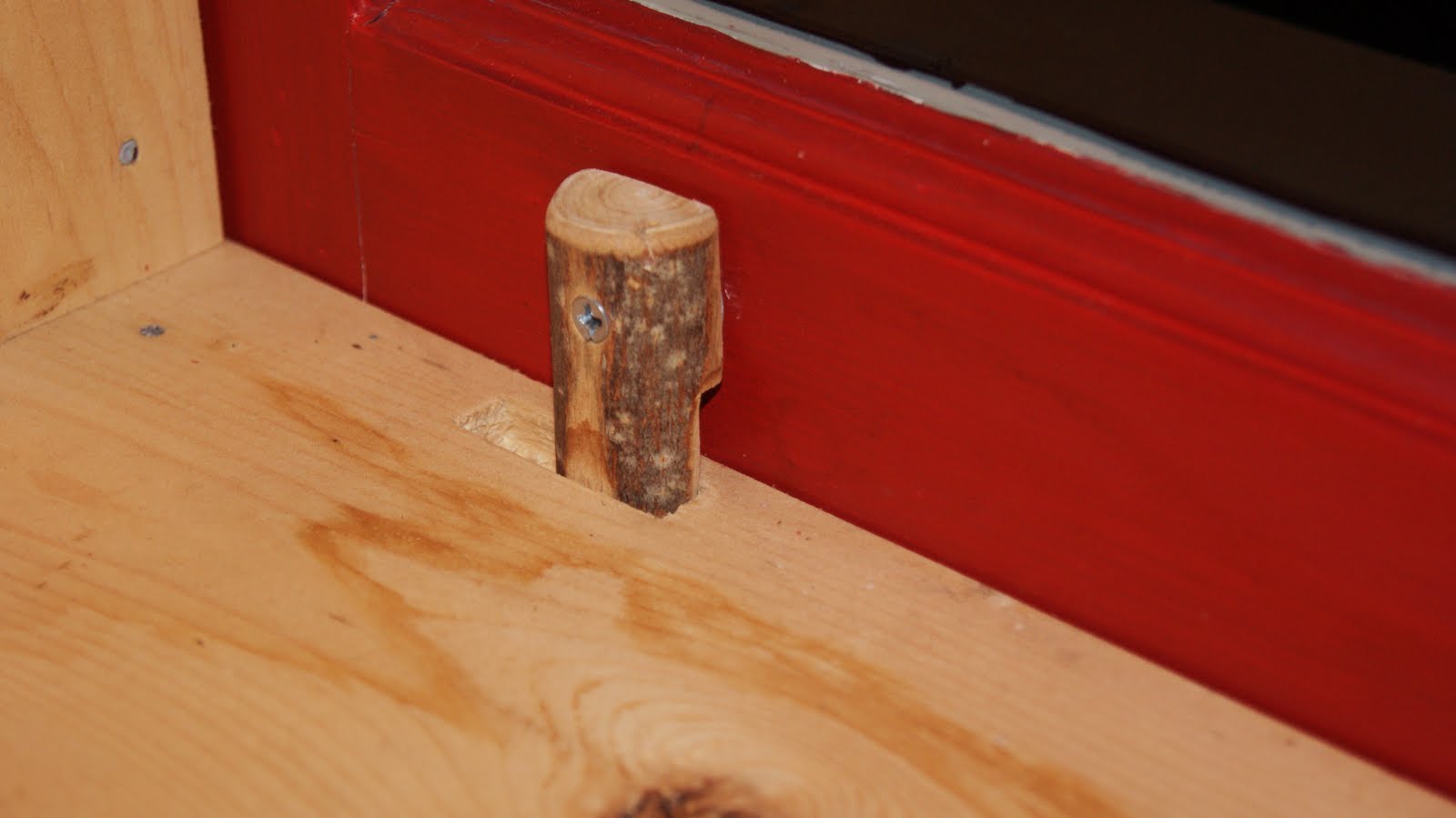
Our trip next brought us to Maine. While there I took note of some utilitarian items. You can't find this stuff at Home Depot. The small details are what make things so interesting.


These are small handcrafted latches and a
center window stay. The knob, top photo, and it's
matching brother at the other side turn to lock
shut. The stay, bottom photo, props open the
large top hinged window. 


Door latches at my camp were hand wrought
by a black smith in Bar Harbor, Maine . 


Northeast Harbor, Maine. While photographing this beautifully
designed and built garden entry I couldn't help but note
the lever/catch. Made of brass and apparently custom,
it has a nautical feel while at the same time fits wonderfully
with the Japanese inspired gate. And it works seamlessly, I tried.
This is the matching side gate. Here the catch
latches on  to a brass receiver that has been
bent to match the profile of the round gate post.
So well thought out. 

Thursday, March 10, 2011

When everything is a good thing

A few years ago I was lucky to have several visits to Skylands, a large home built on Mount Desert Island, Maine. Origianlly built by Edsel Ford in the 1920's and now owned by Martha Stewart, it is the epitome of excellent design using local materials, well planned siting and charming landscape. Although Ms. Stewart has done much with the house, including the creation of original garden elements that had never been built, most of the accolades go to architect Duncan Chandler and landscape designer Jens Jensen. The most striking effect (at least to me) is that the house wasn't placed at the highest point on it's sixty acres. Instead it was placed into the hillside by blasting ledge to accommodate the house, while at the same time helping supply the granite that forms the shell. Had the home been placed at the top, approximately thirty feet higher than it's present site, it would afford a better view, however, it also would have been visible from many vantage points in town or from the water. It would have marred the bucolic element that has made the area so famous. This was, it appears, a conscience decision to sacrifice the better ocean view for a greater aesthetic.
The nestling of the house into the carved hillside allows for a coziness that would normally be hard to achive for such a large house. It's seldom that I can't find something to critique, but as I look over all of my photos from those visits I'm still stymied to find a shortcoming. Granted there was a great deal of capital used to produce this elegant edifice, but it's more about what we can take away to find use in our own more modest circumstances.

Entry

View from the highest point looking out over Skylands

Wednesday, March 9, 2011

Staying close to home

Local materials have an important place in the house and garden. I'm not always able to use the stone, tile or lumber that can be harvested or made close to the construction site (see previous post about 'Indian Block'), but when possible local products add a tone of regionalism. This ethos is particularly fitting in the garden, where native stone and plants help to define locale. Modern or traditional architecture equally benefit and, when used with proportion and scale, can fit seamlessly into the landscape. In addition to the aesthetic, local materials, like the local grown food movement, is a good environmental practice.

Above is my 'camp' entry in Maine and is comprised of stone, spruce, fern and moss (all local) and a somewhat shabby barn. I've also used White Pine needles as a paving material.

And here, back in Key West, I designed some decidedly modern steps using Key Largo coral stone. One of the few native stones available to us here at the end of the road.

About Me

I am a landscape designer based in Key West, Florida and Surry, Maine. I place much attention with the house, not as an adjunct to the garden but as an integral element. This symbiotic relationship will always produce the best and most natural environment. The best description for my views on the relationship between the garden and the house comes from the naturalist Charles Keeler, “landscape design with occasional rooms in case of rain”